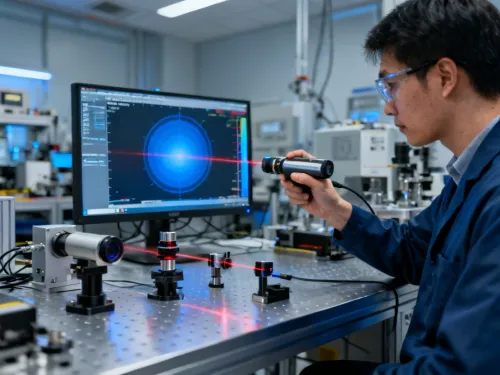
Quantitative tools for measuring, characterizing, and optimizing every parameter of your laser system with traceable accuracy.
Complete beam quality analysis from M-squared measurement to far-field divergence characterization. Our profiling systems support wavelengths from 190nm UV to 16um mid-IR.
NIST-traceable laser power meters and energy sensors spanning eight decades of dynamic range. Thermal, photodiode, and pyroelectric detector technologies cover every laser type and operating regime.
Wavefront sensors, interferometers, and optical spectrum analyzers for characterizing optical components and laser sources with sub-wavelength resolution.
ISO 17025-accredited calibration for laser power meters, energy sensors, and optical instruments. Our calibration laboratory maintains direct traceability to NIST primary standards.
Transparency about what our instruments can and cannot do helps you make better purchasing decisions.
Thermal power sensors offer broadband wavelength coverage and handle high average power, but response times range from 0.5 to 3 seconds depending on sensor aperture. For applications requiring sub-millisecond response, photodiode sensors are necessary -- though they are limited to lower power ranges (typically under 3W) and narrower wavelength bands. Neither technology alone covers all use cases optimally.
Our silicon-based CCD profilers cover 350-1100nm effectively, but deep UV (below 250nm) and mid-IR (above 2um) require specialized pyroelectric or microbolometer arrays with inherently lower spatial resolution (typically 50um pixel pitch vs. 5um for silicon). Customers working at 10.6um CO2 wavelengths should expect spatial resolution approximately 10x coarser than visible-wavelength profiling.
Our published ±1% calibration uncertainty applies to our standard wavelength and power range. At the edges of a sensor's operating range (below 1% or above 95% of full scale), expanded uncertainty increases to ±2-3%. We recommend selecting sensor ranges where your typical measurement falls between 10% and 90% of the sensor's maximum rating for optimal accuracy.
Precision optical measurements are sensitive to ambient conditions. Beam profiler results can be affected by air turbulence (for beam paths exceeding 2 meters in non-controlled environments), and thermal sensor readings drift slightly with ambient temperature changes. We specify all instruments at 23±2 degrees Celsius. Operating outside this range introduces additional uncertainty that customers should account for in their measurement budgets.
Unlike third-party instrument resellers, MKS designs and manufactures the sensors, optics, and electronics inside our measurement instruments. This vertical integration means we understand the physics behind every specification we publish -- including the edge cases where performance degrades.
Tell us your laser parameters and measurement objectives. Our metrology specialists will recommend the optimal instrument configuration and provide a formal quotation.
Request Metrology Consultation